
AERB Directive No. 01/2010
[Under Rule 3, 5 and 6 of the
Atomic Energy (Radiation Protection) Rules 2004] Ref.No. No.CH/AERB/OPSD/25125/2010
dated November 26, 2010 Subject: Exclusion, Exemption and Clearance of Radionuclides in Solid Materials
Radioactive practices in India are governed by the Atomic Energy (Radiation Protection) Rules 2004. As per sections 5 and 6 of the rules and the current IAEA strategy, some of the radioactive practices and sources within practices need not be subjected to regulatory control based on the principle of exclusion, exemption and clearance. The terms exclusion, exemption and clearance are defined as;
Exclusion means the deliberate exclusion of a particular category of exposure from the scope of an instrument of regulatory control on the grounds that it is not considered amenable to control through the regulatory instrument in question.
Exemption is the determination by the regulatory body that a source or practice need not be subject to some or all aspects of regulatory control on the basis that the exposure (including potential exposure) due to the source or practice is too small to warrant the application of those aspects.
Clearance is the removal of radioactive materials or radioactive objects within authorized practices from any further regulatory control by the regulatory body.
The criteria for exclusion, exemption and clearance of radionuclides in solid materials within radioactive practices have been examined by AERB from the consideration of regulatory control. Accordingly, the following directives are hereby issued:
Solid materials containing unmodified concentrations of naturally occurring radionuclides in raw materials, except the radioactive materials / waste generated from operation of
Uranium and Thorium mining and milling facilities, are excluded from the regulatory requirements. 40K in the human body and cosmic radiation on the surface of the earth also come under exclusion.
Exemption of artificial radionuclides in moderate amount of solid materials (upto one tonne) shall be based on the radionuclide levels prescribed in Table-1. For radionuclides of natural origin Table-1 applies if these radionuclides are incorporated into consumer products, or used either as a radioactive source (e.g. 226Ra, 210Po) or for their elemental properties (e.g. thorium, uranium).
Exemption / clearance of artificial radionuclides in bulk amount of solid materials shall be based on the radionuclide levels prescribed in Table-2.
Clearance of naturally occurring radionuclides in bulk amount of solid materials from any authorized practice shall be based on the radionuclide levels prescribed in Table-3.
For exemption / clearance of a mixture of radionuclides in solid materials, the sum of the ratios of the concentration of individual radionuclides present in the solid material to the levels prescribed for the corresponding radionuclide in the respective table shall be less than unity.
Exemption / clearance of radionuclides in solid materials in excess of the levels prescribed in the respective tables or those not prescribed shall be subject to the specific approval of AERB.

AERB Directive No. 02/2011 [Under Rule 14(3) of the Atomic Energy (Radiation Protection) Rules 2004]
Ref.No. No.CH/AERB/ITSD/125/2011/1508 dated April 27, 2011
Subject: The Specifications for Radiation Symbol and Warning Sign
In exercise of rule 14(3) of the Atomic Energy (Radiation Protection) Rules, 2004, the Chairman, Atomic Energy Regulatory Board, being the Competent Authority under the said rules, hereby issues an order prescribing the specifications for the radiation symbol and warning sign.
Specifications for radiation symbol/warning sign:
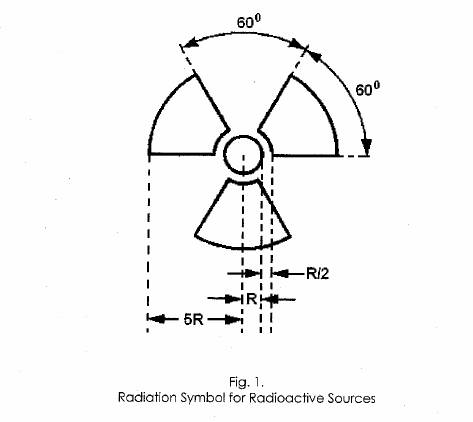
The radiation symbol for radioactive sources other than medical diagnostic and industrial x-ray radiography equipment shall confirm to the specifications given hereunder;
The relative dimensions of the trefoils and the central circle shall be as shown in Fig.1.
The trefoils and the circle shall be of magenta colour.
The background of the above symbol shall be yellow.
The symbol should be accompanied by appropriate legend in English, Hindi and local language indicating radiation hazard and restricted entry, e.g. CAUTION – RADIOACTIVITY.
Small objects, containing radioactive material may, however, have on them only the aforesaid trefoil symbol engraved in a conspicuous colour when their dimensions do not permit compliance with (d) above.
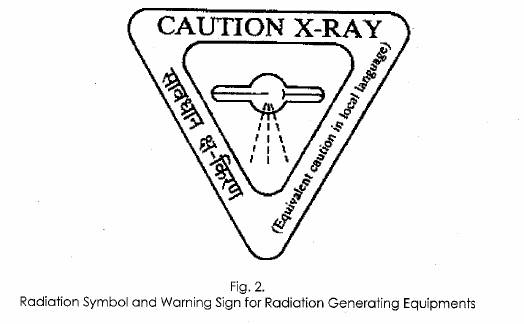
The radiation symbol for radiation generating equipment such as medical diagnostic x-ray equipment, industrial x-ray radiography equipment and accelerators shall have a warning sign as illustrated in Fig.2 and the warning sign shall conform to the specifications given hereunder;
The triangle shall be equilateral.
The ratio of the outer to the inner sides of the triangle shall be 1.5.
The area between the outer and inner triangle shall be in yellow colour on white background.
The printing on the area between the outer and inner triangle and figure inside the inner triangle shall be bold, proportional and red in colour.
The area between the outer and inner triangle should be accompanied by appropriate legend in English, Hindi and local language indicating radiation hazard and restricted entry.
Signed By Shri S.S. Bajaj, Chairman, AERB
AERB Directive No. 01/2011
[Under Rule 15 of the Atomic Energy (Radiation Protection) Rules 2004]
Ref.No. No.CH/AERB/ITSD/125/2011/1507 dated April 27, 2011
Subject: The Dose Limits for Exposures from Ionising Radiations for workers and the members of the public
In exercise of rule 15 of the Atomic Energy (Radiation Protection) Rules, 2004, the Chairman, Atomic Energy Regulatory Board, being the Competent Authority under the said rules, hereby issues an order prescribing the dose limits for exposures from ionising radiations for workers and the members of the public, which shall be adhered to. Dose Limits
General
-
The limits on effective dose apply to the sum of effective doses from external as well as internal sources. The limits exclude the exposures due to natural background radiation and medical exposures.
-
Calendar year shall be used for all prescribed dose limits.
-
Occupational Dose Limits
-
Occupational Workers
The occupational exposures of any worker shall be so controlled that the following limits are not exceeded:
-
an effective dose of 20 mSv/yr averaged over five consecutive years (calculated on a sliding scale of five years);
-
an effective dose of 30 mSv in any year;
-
an equivalent dose to the lens of the eye of 150 mSv in a year;
-
an equivalent dose to the extremities (hands and feet) of 500 mSv in a year and
-
an equivalent dose to the skin of 500 mSv in a year;
-
limits given above apply to female workers also. However, once pregnancy is declared the equivalent dose limit to embryo/fetus shall be 1 mSv for the remainder of the pregnancy.
-
Apprentices and Trainees
The occupational exposure of apprentices and trainees between 16 and 18 years of age shall be so controlled that the following limits are not exceeded:
-
an effective dose of 6 mSv in a year;
-
an equivalent dose to the lens of the eye of 50 mSv in a year;
-
an equivalent dose to the extremities (hands and feet) of 150 mSv in a year and
-
an equivalent dose to the skin of 150 mSv in a year.
-
-
Dose Limits for Members of the Public
-
The estimated average doses to the relevant members of the public shall not exceed the following limits:
-
an effective dose of 1 mSv in a year;
-
an equivalent dose to the lens of the eye of 15 mSv in a year; and
-
an equivalent dose to the skin of 50 mSv in a year.
-
Signed By Shri S.S. Bajaj, Chairman, AERB
AERB Directive No. 01/09
[under Rule 5 of the Atomic Energy (Radiation Protection) Rules, 2004]
Ref.No. No. CH/AERB/IPSD/78/2009 dated March 19, 2009
Subject: Use of Phosphogypsum in Building & Construction Materials & in Agriculture
Rock phosphates imported in India by the fertilizer plants for production of phosphoric acid contain small concentrations of radioactive nuclides, viz., Uranium-238 and Radium-226. Phosphogypsum produced as byproduct during wet processing of imported rock phosphates contains activity concentration of U-238 typically in the range 0.1-0.2 Bq/g and Ra-226 typically in the range 0.5-1.3 Bq/g.
The subject of processing of imported rock phosphates and the use of phosphogypsum so produced in commercial applications like Building and Construction Materials and in Agriculture has been examined in the Atomic Energy Regulatory Board (AERB) from the radiological safety considerations and the following directives are issued.
Analysis of Rock Phosphate and Phosphogypsum: All rock phosphate processing industries shall carry out analysis to determine U-238 and Ra-226 content in each imported consignment of rock phosphate as well as in the phosphogypsum produced from its processing and shall report the results to AERB on quarterly basis. This data will be reviewed in AERB for a period of about two years for deciding on the frequency of such analysis in future.
Sale of Phosphogypsum by Fertilizer Plants: AERB approval is not required for selling phosphogypsum for its use in building and construction materials provided the activity concentration of Ra-226 in it is less than or equal to 1 Bq/g. [If Ra-226 concentration in phosphogypsum is more than 1Bq/g, it is to be mixed with other ingredients such that the Ra-226 activity concentration in bulk material is less than or equal to 1.0 Bq/g.]
Manufacturing and Use of Phosphogypsum Panels and Blocks :AERB approval is not required for manufacturing and use of phosphogypsum panels or blocks provided they have Ra-226 activity less than 40 kBq/square metre area of any surface of the panels/blocks.
Use in Agriculture :There is no restriction for use of phosphogypsum in agricultural applications from the radiological safety considerations.
Signed By Shri S.K. Sharma, Chairman, AERB
AERB Directive No. 01/09
[under Rule 5 of the Atomic Energy (Radiation Protection) Rules, 2004]
Ref.No. No. CH/AERB/IPSD/78/2009 dated March 19, 2009
Subject: Use of Phosphogypsum in Building & Construction Materials & in Agriculture
Rock phosphates imported in India by the fertilizer plants for production of phosphoric acid contain small concentrations of radioactive nuclides, viz., Uranium-238 and Radium-226. Phosphogypsum produced as byproduct during wet processing of imported rock phosphates contains activity concentration of U-238 typically in the range 0.1-0.2 Bq/g and Ra-226 typically in the range 0.5-1.3 Bq/g.
The subject of processing of imported rock phosphates and the use of phosphogypsum so produced in commercial applications like Building and Construction Materials and in Agriculture has been examined in the Atomic Energy Regulatory Board (AERB) from the radiological safety considerations and the following directives are issued.
Analysis of Rock Phosphate and Phosphogypsum: All rock phosphate processing industries shall carry out analysis to determine U-238 and Ra-226 content in each imported consignment of rock phosphate as well as in the phosphogypsum produced from its processing and shall report the results to AERB on quarterly basis. This data will be reviewed in AERB for a period of about two years for deciding on the frequency of such analysis in future.
Sale of Phosphogypsum by Fertilizer Plants: AERB approval is not required for selling phosphogypsum for its use in building and construction materials provided the activity concentration of Ra-226 in it is less than or equal to 1 Bq/g. [If Ra-226 concentration in phosphogypsum is more than 1Bq/g, it is to be mixed with other ingredients such that the Ra-226 activity concentration in bulk material is less than or equal to 1.0 Bq/g.]
Manufacturing and Use of Phosphogypsum Panels and Blocks :AERB approval is not required for manufacturing and use of phosphogypsum panels or blocks provided they have Ra-226 activity less than 40 kBq/square metre area of any surface of the panels/blocks.
Use in Agriculture :There is no restriction for use of phosphogypsum in agricultural applications from the radiological safety considerations.
Signed By Shri S.K. Sharma, Chairman, AERB
SAFETY DIRECTIVE NO. 2, 1991
Ref.No. Nil July 22, 1991
All future plants/facilities including those under design shall be based on ICRP-60 which recommends that the dose constraint for optimisation should not exceed 20 mSv in a year for occupational exposures and 1 mSv in a year for the public. In compliance of this:
The shieldings to be provided shall be such that the dose rates in full occupancy areas do not exceed 1 microSievert per hour (0.1 mRem per hour).
The ventilation designs shall be such that the air concentration of the activities in full occupancy areas do not normally exceed 1/10 of the new derived air concentrations (DAC). The new DAC values can be obtained by dividing the annual limit on intake (ALI) values given in ICRP-61 by 2.4E3. (These ALI values for commonly encountered radionuclides are given below).
All effluent discharges from a plant/facility/practice shall be so controlled that the exposure of the critical group does not exceed the public dose limit of 1 mSv in a year (excluding natural background and medical exposures) from all practices at the site.
Nuclide & aerosol class | - | ALI (1991) (Bq) | Ratio ALI(1991)/ALI(1977) |
H-3 (tritiated water vapour) | - | 1E9 | 0.33 |
Co-60 | W | 2E6 | 0.33 |
Co-60 | Y | 4E5 | 0.40 |
Sr-90 | D | 4E5 | 0.57 |
Sr-90 | Y | 6E4 | 0.60 |
I-131 | D | 1E6 | 0.33 |
Cs-137 | D | 2E6 | 0.33 |
Th-232 | W | 90 | 2.25 |
Th-232 | Y | 90 | 0.90 |
U-238 | D | 9E4 | 1.80 |
U-238 | W | 1E4 | 0.33 |
U-238 | Y | 600 | 0.30 |
Pu-239 | W | 300 | 1.50 |
Pu-239 | Y | 300 | 0.60 |
Am-241 | W | 300 | 1.50 |