
Nuclear Safety Studies
During the formative days of SRI, it was envisaged that the country would expand its nuclear programme by deployment of advanced and new generation nuclear power plants in association with integral fuel cycle facilities. To carry out effective regulation of these new systems and facilities, utmost importance was given to develop technical expertise in the areas of reactor physics and radiological safety. In view of this, SRI has aptly selected research topics in the areas related to advanced light water reactors, fast breeder reactors, nuclear fuel cycle and radiological impacts arising from these systems. Recently, a radiation physics laboratory has been setup to start experimental programme for validation of codes and computational methods adopted in radiation transport studies. Going further ahead, a research programme on High Energy Dosimetry in collaboration with the Medical Physics Department of Anna University, Chennai is also initiated. The salient contributions and highlights of the important research works are delineated in the following sections.
A)Reactor Physics Studies
Light Water Reactor Studies
Analysis of Reactor Core Scenario of Kudankulam (KK) Unit-1 VVER-1000 Reactor: Initial fuel loading, First approach to criticality and Phase B & C physics experimentsTheoretical analyses of Initial Fuel Loading, First Approach to Criticality, Phase-B low power physics experiments and Phase-C physics experiments at various power levels were carried out for KK VVER-1000 reactors using indigenous deterministic computer code systems. The analyses include the following:
Loading of fuel assemblies in dry condition and filling of moderator with high boron content approach to first criticality using boron dilution,
Individual, group wise and integral worth of control protection system absorber rods and also emergency protection system,
Power distribution, temperature coefficient of reactivity as a function of boron and boric acid coefficient of reactivity etc.
VVER-1000 reactors usually attain criticality at Hot Zero Power (HZP) state by removing soluble boron from moderator. At this low power, reactivity feedbacks are least effective and thus Reactivity Initiated Accident (RIA) occurring during the startup could be very severe. In view of this, reactivity insertion transients (RIT) at HZP in KK VVER-1000 reactors were studied. Reactivity insertions due to ejection and withdrawal of a single and the entire working group (Group-10) of Control Protection and System Absorber Rods (CPSARs) have been considered for RIT analysis at HZP using a state of art inhouse developed 3D Space-time kinetics code.
Validation of computational tools for the design analysis of modern light water reactors (LWR) has become important in view of the current plans for deployment of a variety of modern LWRs in India. To gain better insight, a benchmark problem suite proposed by Japan Atomic Energy Research Institute (JAERI) for reactor physics study of LWR next generation fuels was analyzed. The fuel enrichments of the proposed LWR fuels are higher than the conventional fuels and discharge burnup target is around 70 GWd/t. The uranium oxide and mixed oxide fuel pin cell models of PWR were simulated to study the core behavior at high fuel burnup conditions.
To establish the required expertise for advanced LWR reactor physics safety evaluation, steady state core neutronics analysis of a typical European Pressurized Water Reactor (EPR) has been taken up at SRI. The study includes lattice level calculations of EPR using an advanced lattice burnup code. Important core physics parameters like effective neutron multiplication factors (Keff) for various reactor states, worth of control and shutdown banks and delayed neutron fraction were calculated.
Fuel Cycle Studies
During nuclear power generation, highly radiotoxic by-products such as the minor actinides are formed, which accumulate in spent fuel storage or reprocessing plants on a larger scale. To minimize the long-term radio toxicity risk from these minor actinides, theoretical and experimental studies are undertaken to transmute the long lived minor actinides to short lived or stable species. As for example, the transmutation characteristic of Am-241, one of the major contributors to the radio toxicity in the spent nuclear reactor fuel, was analyzed in both thermal and fast reactor neutron spectra and the superiority of fast neutron spectrum for effective transmutation has been established.
Fuel depletion calculations coupled with Monte Carlo (MC) neutronics codes have gained attention due to its ability to accurately model complex geometries with better estimation of various nuclide inventories. In view of this, a computational module has been developed that performs time-dependent burnup calculations by combining an existing MC based neutronics code with a ORIGEN type nuclear fuel burnup code.
The Neutronics code is capable of providing the neutron flux and effective one-group (1G) cross sections for different regions of the reactor core as an input to the fuel burnup code. The fuel burnup code in turn performs multi-nuclide depletion calculations for each specified region of the core and provides material compositions for next MC simulations. By using such a coupling scheme, accurate burnup dependent studies can be carried out for any type of reactor geometry.
B) Radiological Safety Studies
In-homogeneities in shield structures lead to considerable amount of leakage radiation (streaming) giving rise to increased radiation levels in accessible areas. It is very difficult to evaluate and quantify the streaming radiation doses due to radiation propagation through the in-homogeneities like ducts and voids present in the shields, as the shield structures are complex and there is no general approach or empirical formula found suitable for solving all kinds of shielding problems. Towards these objectives, prototype gamma and neutron streaming experiments have been carried out simulating various in-homogeneities present in bulk shields.
(i) Gamma streaming experiments
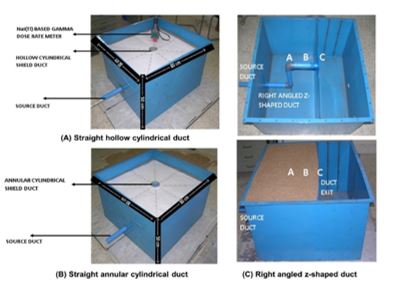
Gamma radiation streaming experiments were carried out by using a setup consisting of a stainless-steel box of dimensions 80 cm X 80 cm X 50 cm filled with sand as shield material and a Co-60 gamma source. Straight hollow cylindrical, annular and right angular z-shaped ducts were used as in-homogeneities in sand shielding material for the study. The gamma radiation streaming through these ducts were measured by a NaI (Tl) based hand held gamma spectrometer. The figures below depict the experimental setup and few sample results obtained through the study.
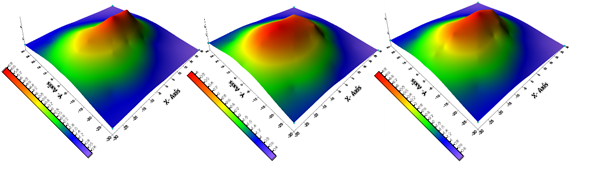
St. Hollow Cylindrical Duct St. Annular Cylindrical Duct (Rin=2.9 cm) St. Annular Cylindrical Duct (Rin=1.7 cm)
(ii) Neutron streaming experiments
Neutron streaming experiments were carried out in a proposed accelerator facility of IGCAR. The accelerator hall consists of few trenches for laying the cooling channels, power and control cables to the the control room. Neutron streaming experiments were conducted in one of the trenches by keeping a standard Am-Be neutron source at the entrance point of the trench. A pictorial view of the experimental arrangement is shown in the figure. Dose rates were measured at five locations along the trench including its entrance and exit end. Neutron monitor, REM counter and neutron spectrometer were used to measure neutron dose rates. The results of the experiments were compared with theoretical Monte Carlo simulations to validate the neutron streaming analysis methodology.
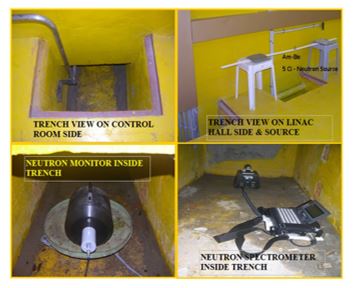
Schematic of neutron streaming experimental setup
The major sources of external radiation and radioactivity in the environment are due to the gamma radiation emitted from naturally occurring radio nuclides such as 40K, and the radioactive decay products from uranium (238U) and thorium (232Th) in the environmental materials. Gamma spectroscopic devices such as scintillation based NaI(Tl) detector and high purity germanium (HPGe) detector available at Radiation Physics Laboratory of Safety Research Institute (SRI) are extensively used for measuring the radioactivity present in the soil and coastal sediment samples collected from various sites within the country.
C) Fast Reactor Studies
The Prototype Fast Breeder Reactor (PFBR) is in advanced stage of construction and expected to attain criticality in near future. PFBR is a 500 MWe sodium cooled, pool type, mixed oxide fuelled reactor. Owing to the significance of this reactor being the first of the kind designed indigenously in the country, SRI has taken keen interest in the evaluation of the reactor physics aspects of PFBR in order to support the regulatory decision making.
The overall nuclear power growth in India will mostly depend on the faster growth of Fast Breeder Reactors (FBRs). Metal fuel cycle is the appropriate choice for achieving a faster growth of FBRs, which offers higher breeding gain and lower fuel doubling time. In view of this, several metal fuelled fast breeder reactor (MFBR) designs with Uranium-Plutonium-Zirconium ternary alloy fuel have been conceptualized. As a research work, MFBR cores with varying power level and fuel composition have been analyzed to evaluate their physics parameters and breeding behavior vis-à-vis conventional MOX fuelled fast reactors. More details on the study are found in SRI highlights (2010-14).
Utilization of the vast thorium reserves in India has been pursued vigorously for establishing energy sustainability through nuclear power. For effective utilization of thorium, one of the choice could be a metal fuel based fast reactor, which can attain higher breeding gain. As a R&D topic, the effect of thorium introduction in the blankets of a conceptualized in a high power MFBR core has been studied. The results of the study are encouraging from overall fissile breeding capability and safety point of view.
As an integral part of safety evaluation, it is necessary to analyze the dynamic behavior of fast reactors and establish their stability range under different reactivity insertion conditions. Attempts are made to develop indigenous computational tools in modern software environment for studying the following aspects of fast reactors:
Transient over power (e.g. uncontrolled withdrawal of absorber rod) events
Loss of flow and loss of heat sink conditions which lead to unsafe reactor states
Characterization of stable dynamic regimes: A mathematical model is developed based on control system theory through state-space formalism.